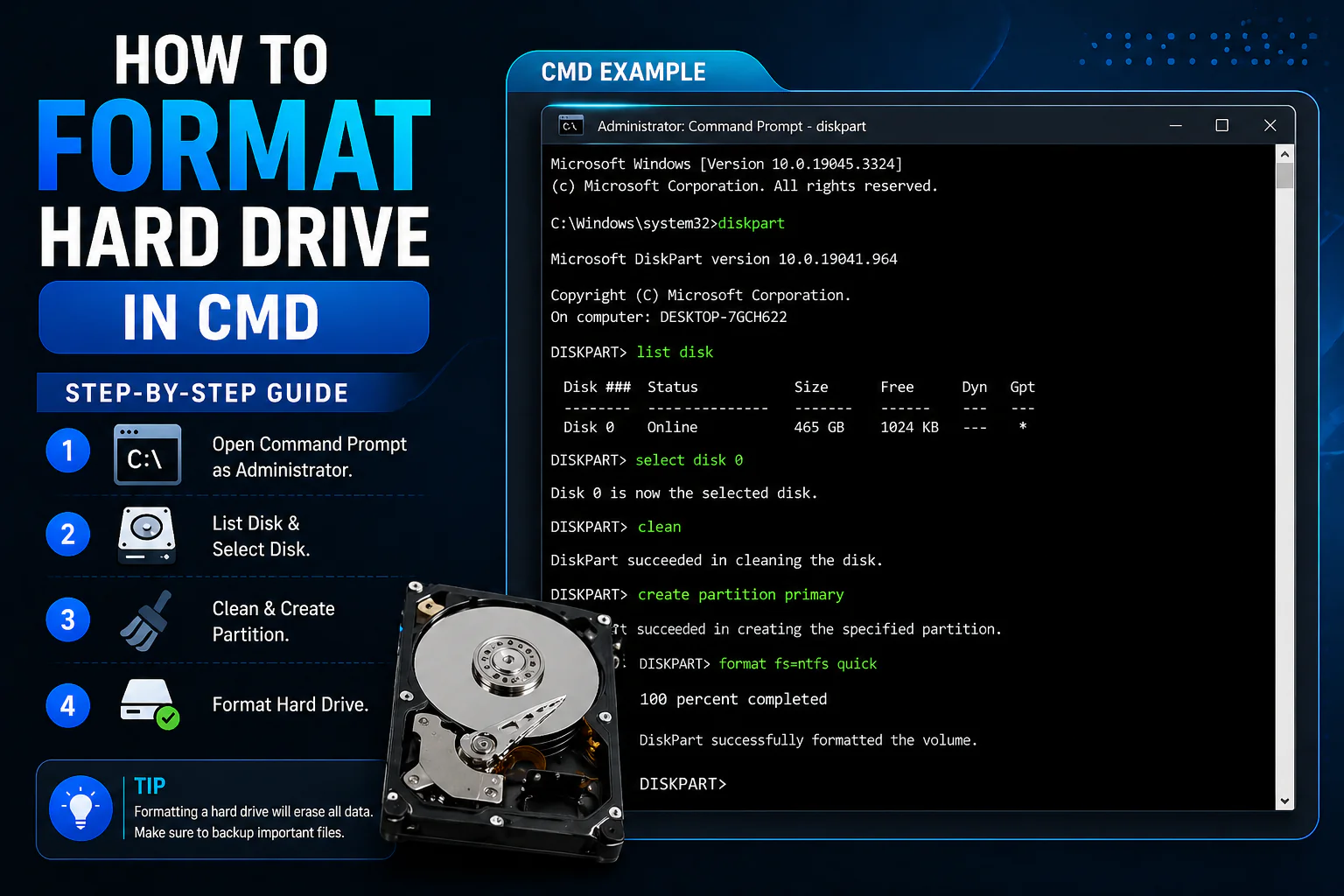

Formatting a hard drive is very integral and though it might seem to be a straightforward task, requires usefulness of attention. Formatting can help to remove the existing data from a drive, repair corrupted drive partitions, prepare storage drives for installation of a fresh OS e.g. Microsoft Windows, and of course, being able to re-use an existing storage drive.
Many of formatting drives’ through Microsoft File Explorer or Disk Management and though these forms of tools are pretty useful, these options can be just plain crippled. In this circumstances, it is beneficial to learn how to Format Hard Drive in CMD.
CMD is the Command Prompt in Microsoft Windows and is one of the best tools there are on the Microsoft Windows OS for managing disks and partitions as well as the file systems through command. Other than internal and external hard drives, you could also format other storage drives e.g. flash, drives, memory drives, etc. and is also let drivers issues be effectively resolved. Three issues dealing with drives can easily be performed via functionality of the CMD format command.
Hard Drive Formatting in CMD: Step by Step
This guide is designed to teach you to format a hard drive using the command line — with some prerequisites included. CMD is a powerful utility for navigating and executing commands. CMD can save you precious time, but it is nothing if you do not know the specific commands you can (and cannot) execute. Formatting a drive is a big deal; formatting in CMD is a big deal. We will tackle some a few formatting commands, as well as the specific precautions/tips you should take in order to avoid losing critical files or crashing your system before we begin.
Advanced Warning
Okay, forms of command line formatting mean you are about to erase files that are located on the hard drive you are executing the command on. Before you type the critical formatting command, please take the time to back up files you deem important. Once files are erased in CMD, you cannot collect them again without third party software.
Additionally, take the time to consider the drive/number you should place. If you are in a CMD instance and format the wrong drive/number, you are one command line away from formatting the drive of your choice. CMD is especially dangerous for those with an array of multiple drives.
Defining Formatting
CMD has its own utility, much like some other capacities in an operating system. You can initialize a new drive in multiple ways. However, different file systems utilize different methods for how the drive operates.
When it comes to formatting and CMD, you can choose a few different options. For the sake of brevity, the choices are:
Quick Formatting
When executed, CMD aligns the operating system file structure to the system on the drive, to the operating system.
Full Formatting
Essentially, a full format resets your drive to factory settings. This command is best used when you suspect your storage system is corrupted in some way.
When formatting a hard drive using CMD, you have two options: either the quick format or the full format.
Why Use CMD to Format a Hard Drive?
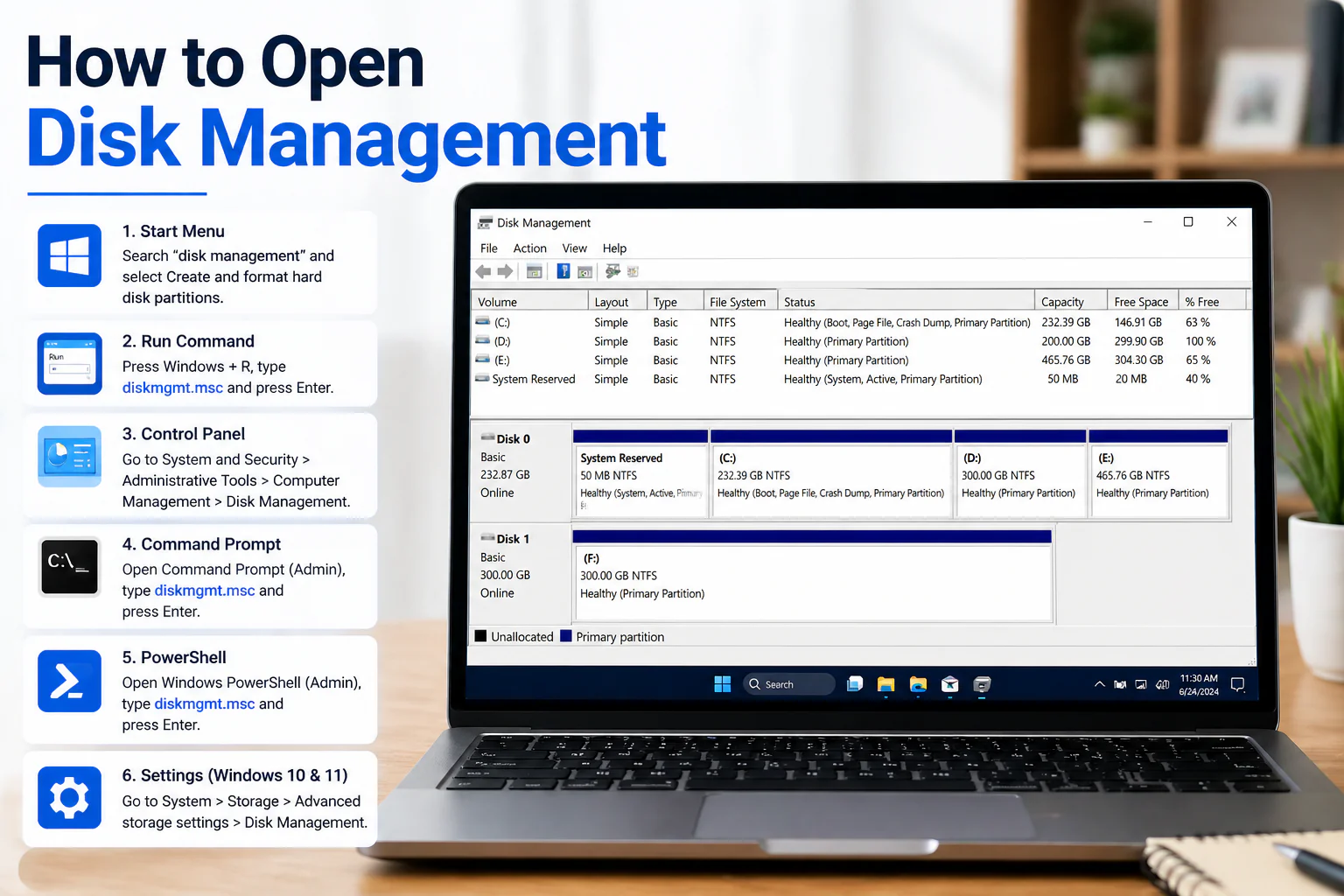
Some people might ask, “Why CMD? Isn’t there File Explorer and Disk Management?” That’s a good question. The tools in the taskbar generally should do the job. However, CMD is generally more useful and helpful when the taskbar tools fail.
These are the benefits of using CMD:
1. CMD Works When File Explorer Doesn’t
File Explorer is the most common formatting tool for most people. However, sometimes it can’t format a drive. In some cases, it will only display an error message, saying, “Windows was unable to complete the format.” In those cases, using CMD is often the only way to format the drive.
2. CMD Gives Better Control of the Disk
With CMD, you can clean a disk and create and assign partitions a drive letter. But you can also convert the partition style. CMD is also useful when formatting a drive.
3. CMD Can Control Drives That Have Been Corrupted
Most external drives will become corrupted over time. In those cases, using certain CMD commands can help clean and format the drives to default.
4. CMD Can Help in Certain Scenarios During Windows Installation
During Windows installation, there are times when you have to clean or format a drive. The CMD you can find by using the Windows recovery or Installation Environment is pretty useful in those scenarios.
5. CMD Can Save Time
For more experienced users, CMD is the easiest and fastest way to do formatting and managing tasks for drives. It is faster because you can do everything using commands rather than using the mouse to do multiple clicks.
When Is CMD Formatting Most Useful?
Formatting a drive using CMD is most helpful in the following situations:
- File Explorer can’t perform the format.
- Your external drive format has an error.
- Your USB drive is corrupted or has an error.
- Disk Management is not responding properly.
- You wish to erase a drive before disposing of it.
- You want to make an installation drive for Windows.
- You want to carve out a new partition.
- Your drive has an incorrect file system.
- You want to convert or arrange the disk structure.
Technical File system CMD Formatting
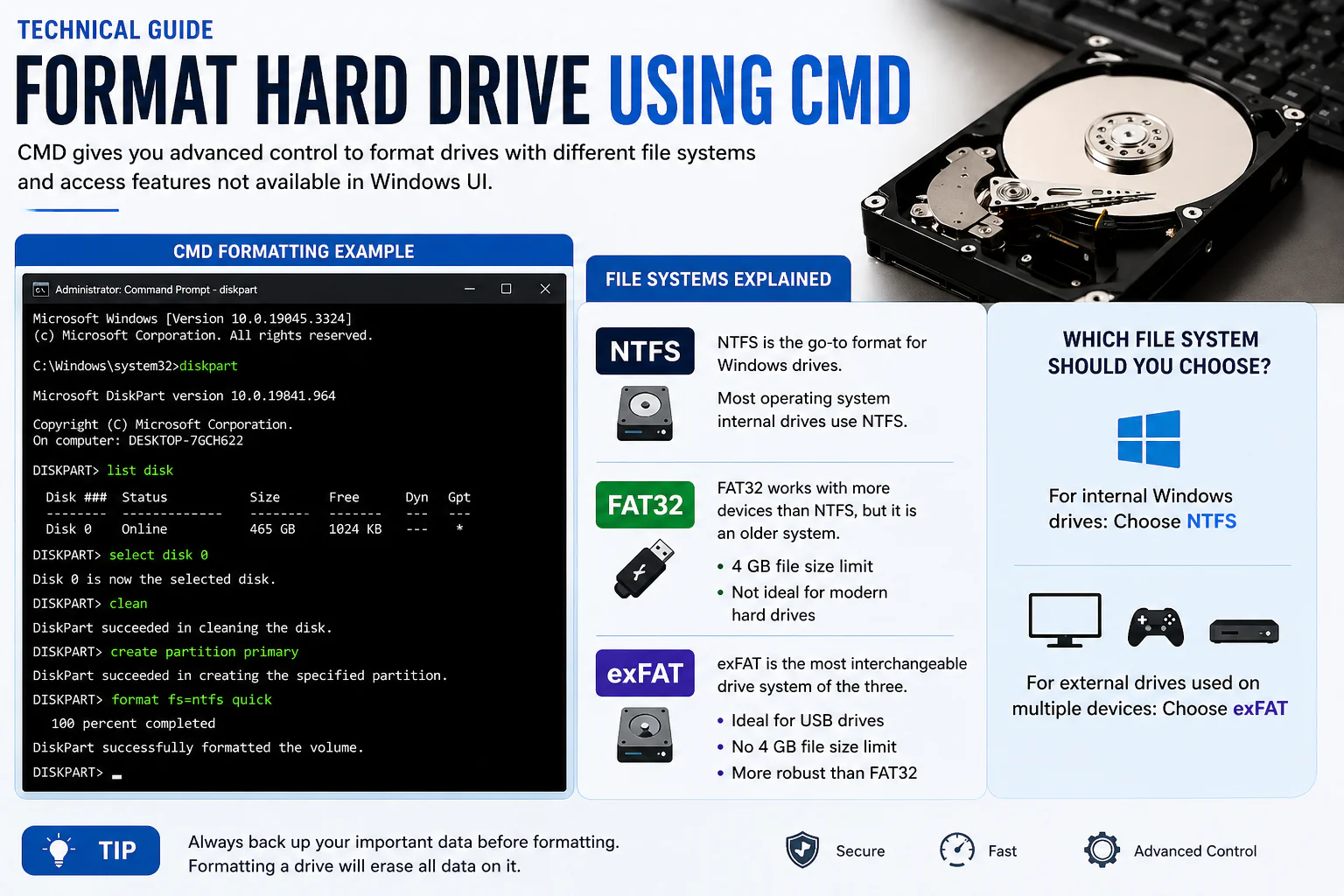
becomes even more valuable CMD accessing those features not available in the Windows UI.
File Systems: NTFS, FAT32, isexFAT
Before formatting a drive, it is important to understand how file systems differ.
NTFS
NTFS is the go-to format for Windows drives. Most operating system internal drives use NTFS.
FAT32
FAT32 works with more devices than NTFS, but it is an older system. FAT32 self-imposes a 4 GB file size limit. FAT32 has no place on a modern hard drive.
exFAT
exFAT is most interchangeable drive system of the three. It is a format most used for USB drives due to the file size limit, and it has a more robust system than FAT32.
If you plan to format a hard drive for Windows, you should stick with NTFS. You can choose exFAT for an external hard drive that you’ll want to connect to multiple devices.
Method 1: Format Hard Drive with CMD (Command Line) using Format Command
This method is the simplest for when a drive is assigned a letter (e.g. D:, E:, or F:).
Step 1: Start Command Prompt with Admin Privileges
Go to the Start Menu, type cmd, right-click Command Prompt, and click Run as administrator.
Step 2: Verify the Driver Letter
Before you format it, check which drive letter it is in File Explorer. For example, it might be the E: drive.
Step 3: Format the Drive
To format the drive with NTFS, enter the following command.
format E: /fs:NTFS /q /v:EnableStorageIn this example:
E: is for the drive letter.
/fs:NTFS is for NTFS format/q is for quick format/v:EnableStorage is for the drive label.
E: can be replaced with whichever letter your USB drive is.
To format it for exFAT:
format E: /fs:exFAT /q /v:NomExternalDriveIf the command window asks, confirm with a Y and enter.
When a drive is visible in command prompt, this is a quick method for formatting.
Method 2: Format Hard Drive with CMD using DiskPart
For formatting the drive, DiskPart is more advanced than the format command. It is the method of choice for when a drive has multiple partitions, is not displayed for some reason, or to completely delete everything.
Step 1 – Open CMD as Administrator
Search CMD, right-click, and `Run as administrator`.
Step 2 – Start DiskPart
Type:
diskpartThen hit `Enter`.
Step 3 – List All Disks
Type:
list diskIt shows you all the disks. You will see disk numbers like Disk 0, Disk 1, Disk 2 etc.
Disk 0 is your main drive. Pick the right disk.
Step 4 – Select the Disk
This example will assume the disk to format is Disk 1, then type:
select disk 1And hit `enter`.
Step 5 – Clean the Disk
To fully wipe the disk, type:
cleanIt will reset the drive to an unallocated state.
Step 6 – Create a New Partition
Create a primary partition:
create partition primaryStep 7 – Format the Drive
To format the drive as NTFS, type:
format fs=ntfs quickIf you want to use exFAT instead, replace `ntfs` with `exfat`.
Step 8 – Assign a Drive Letter
Assign the drive letter you want:
assign letter=EYou can substitute `E` with any letter you want.
Step 9 – Exit DiskPart
Type:
exitAnd close CMD.
Your drive should be good to go and ready to use!
Format Hard Drive – DiskPart Command
Here is an example that can be used to format a hard drive using DiskPart in Command Prompt:
shelldiskpartlist diskselect disk 1cleancreate partition primaryformat fs=ntfs quickassign letter=EexitDon’t use this command without double-checking the disk number as the clean command deletes all partitions of the chosen disk.
Clean vs Format Command
There are many users who get confused between clean command and format command, so here’s the distinction:
– The diskpart clean command deletes the partitions of the disk, but it does not automatically create a new filesystem on the disk.
– The format command builds a partition and builds a filesystem on that partition, ex. NTFS, exFAT, etc.
To simplify it even further: clean removes the partitioning of the disk and format builds a filesystem on that partition.
If you already have a working drive, and you only want to remove the existing data, then a simple format command can accomplish this. If you are experiencing partition errors on the Drive or the Drive is not being displayed correctly, then using the Diskpart with the clean command is more effective.
Format Specific Drive in Command Prompt
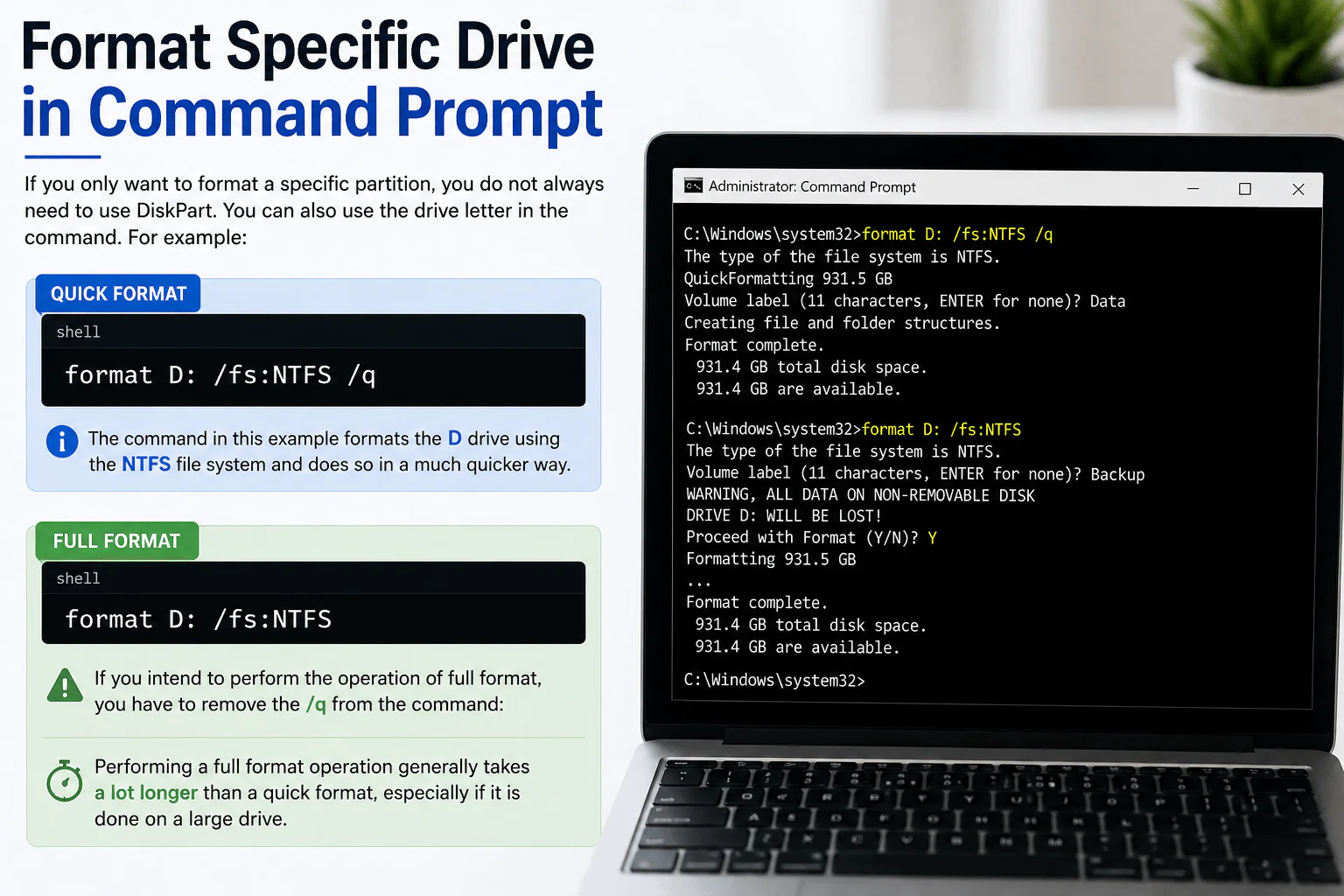
If you only want to format a specific partition, you do not always need to use DiskPart. You can also use the drive letter in the command. For example:
shellformat D: /fs:NTFS /qThe command in this example formats the D drive using the NTFS file system and does so in a much quicker way.
If you intend to perform the operation of full format, you have to remove the /q from the command:
shellformat D: /fs:NTFSPerforming a full format operation generally takes a lot longer than a quick format, especially if it is done on a large drive.
How to Format Write-Protected Drives
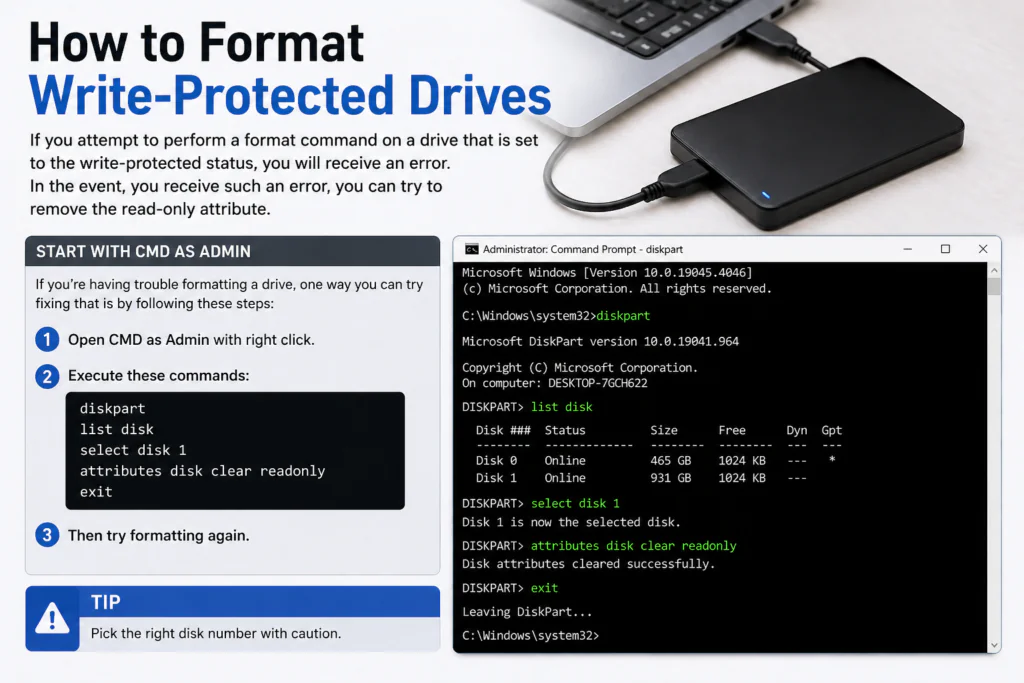
If you attempt to perform a format command on a drive that is set to the write-protected status, you will receive an error. In the event, you receive such an error, you can try to remove the read-only attribute.
Start with CMD as Admin
If you’re having trouble formatting a drive, one way you can try fixing that is by following these steps:
1. Open CMD as Admin with right click.
2. Execute these commands:
diskpartlist diskselect disk 1attributes disk clear readonly
exit3. Then try formatting again.
Pick the right disk number with caution
Choose Between Quick or Full Format
Choose Quick Format:
- The drive is in good shape.
- Rapid reuse is desired.
- It’s a new drive.
- no in-depth error checking is needed.
Choose Full Format:
- The drive is failing.
- The drive has learned slowness or the drive has no kinetic maximization.
- You suspect you may have voltage distortion.
- Kinetic Deep Decayation is desired.
For quick, easy formatting, you’ll usually want to choose a quick format. but the complete format may be a good option if you have slow or failing drives.
Troubles with Formatting Command in Windows
While you’re working with command lines for formatting drives, you’re likely to run into a few common issues.
Format is Fatally Ongoing
Try to create a new partition in DiskPart and format again, only the format command works in the format file commands.
It’s a No-Go
At the Admin command prompt, type the command. SEL may not provide disk formatting commands.
Formatting Kicks
Use the commands of I Open DiskPart and execute the command of attributes disk clear readonly.
Clean Desired
A critical stop is warranted.
No Drives in DiskPart
Use DiskPart with list disk, the disk should be available to friends.
Safety tips before using CMD formatting
Opening powerful functionalities in CMD with formatting expertise holds great potential. However, CMD formatting tips should always be cautiously applied.
- Before implementing CMD formatting options, back up your data.
- Before selecting a drive, check its capacity.
- Avoid formatting a partition where a currently running OS is installed.
- To avoid formatting errors, remove unnecessary external drives.
- Skip the quick format option unless the drive is in good health.
- Never interrupted the formatting.
- Format the drive when the laptop is plugged in.
Follow these safety pointers to avoid unwanted data loss.
Can you format the C Drive using CMD?
Direct formatting of the C Drive is not possible while the OS is running since the OS is installed in the same partition. Therefore, to format the C Drive, you usually have to boot using a Windows installation USB to the recovery environment.
In the midst of Windows installation, in order to initialize CMD, you would have to press the following command keys:
Shift + F10
Opening CMD allows users to format and clean the system drive using an advanced command known as DiskPart. However, cleaning the system drive should only be done if you plan to remove all content to perform a clean Windows install.
Does formatting the drive remove all data?
In most instances, the answer is no. When a drive is formatted using the quick format option, data on the Drive can still be recovered since the deleted files are not lost and can be recovered using recovery software.
For more powerful data removal in DiskPart, you can run the command:
clean allThis command will write zeros to the entire drive. This method is also more powerful than a regular clean, but can take a very long time, especially if you’re using a larger drive.
This command should be handled with caution. It takes longer to run than a normal clean and is more powerful and less reversible.
Disk Management vs. CMD
Disk Management, because it is graphical, is more user-friendly. The user can easily do things like right-click on a drive or create a partition and format a drive with no prior command experience.
Disk Management, however, is less powerful than CMD.
Disk Management is Better When:
- Disk Management Doesn’t Work
- there are drive errors
- more control is needede
- working in recovery mode
- and fixing partition issues
For the average use case, Disk Management is adequate, but if a problem occurs or needs to be fixed, CMD is preferred.
Using CMD to Format Drives: Best Command
There are a few caveats here.
To format a drive using a command, you can do something like the following:
format E: /fs:NTFS /qTo do a full reset of a drive, with the use of DiskPart, the command is:
diskpartlist diskselect disk 1cleancreate partition primaryformat fs=ntfs quickassign letter=EexitThe use of DiskPart is more powerful and is preferred for fixing partitioning issues on said drive.
Conclusion
For Windows users, learning to format hard drives using CMD is an essential and useful skill to develop. It allows users more options in control over their drives and complete formatting when conventional methods fail. CMD proves useful for Windows users when they have to deal with the following situations: fixing corrupted external hard drives, formatting a USB drive, wiping old drives, setting a drive up for a brand new purpose, etc.
Above all else, the most important thing to do is to exercise caution when you format hard drives in cmd. You especially need to ensure you create a complete backup of your important data before formatting, double-check and verify that you identified the selected disk correctly, and that you have a complete and full understanding of CMD on that particular command. This is because it is all too easy to make a quick and easy mistake and select a drive that will end up wiping the wrong one.
For most users, the CMD Format command is perfectly sufficient for most of your needs for basic formatting of drives. Additionally, if you need advanced disk repair or the need to do a complete disk reset, Disks can be advantageous too, DiskPart is a great choice in those situations too. Together with their CMD Format associated commands, disk formatting will become a much more simple, fast, and reliable process.
Questions of CMD and Format Hard Drive
Yes, the CMD command to do basic formatting, along with the option for advanced formatting and some advanced options, is perfectly acceptable to rely on.
A command of this nature is acceptable format E: /fs:NTFS /q
Be sure to replace E: with whatever is the correct drive for your change purpose.
Yes, be sure to command otherwise and backup and important files, etc. or they will be deleted.
DiskPart command is one of the more necessary commands to use also, if you were to have this as your only command that would be acceptable too. But selecting otherwise is a necessary risk to control for a greater loss.
NTFS drives are preferred for internal drives running Windows. For external drives that are compatible with multiple operating systems, go with exFAT.
CMD can be used for formatting drives with the most customization flexibility. It is useful in recovery mode, and can be used to format drives that cannot be formatted using the Windows native formatters.